The numbers behind the job.
The same eight themes we ask every guest about, with what the research says on each. Every figure is sourced. Where nobody has the number, we say so, because that's what the interviews are for.
01The Road In
Session player or artist? Nobody's counting.
There's no reliable UK figure for how many musicians are hired players and how many are the act. The reason is simple: most are both, and a lot more besides.
different music roles held by the average working musician, at the same time.
Someone else's gig on Friday, your own band on Saturday, teaching on Monday. That's what a career in music normally looks like. There's no one way in.
Sources: Musicians' Census, first report, around 6,000 UK musicians. Thomson (2013), Artist Revenue Streams survey, about 5,300 US musicians in 2011; people could pick more than one role.
Watch our guests on The Road In →02The Craft
Hours matter. They're not the whole story.
The famous "10,000 hours" idea came from a study of violinists. Here's what it actually found: practice hours by age 18, as the players remembered them.
of the difference between good and great violinists, in a 2019 repeat of the study. The rest is everything else.
Nobody's measured it. The research is all on students. So we ask every guest.
What the evidence does agree on: short, focused sessions spread across the day beat long grinds. How well you practise matters as much as how long.
Sources: Ericsson, Krampe and Tesch-Römer (1993), summarised in Barry and Hallam (2002), which also covers session length. 2019 replication reported by Smithsonian.
Watch our guests on The Craft →03The Gear
The music shop is under pressure.
There's no official figure for what UK instrument retail is worth. What is clear is that the high street is shrinking.
stores closed overnight when the UK's fourth-largest instrument retailer went into administration.
Another major UK retailer into administration, two months earlier. Both had their stock bought by an online rival.
Rising rents and rates, thin margins and cautious buyers are squeezing shops. Music retail jobs fell for a second year running in 2024.
Sources: MusicTech (June 2025); Gear4music announcement (June 2025); UK Music, This Is Music 2025.
At the other end: nobody is paying for the wood.
The instruments that break records are not the best-sounding ones. With one exception, they are the ones with a story attached. Top auction prices by instrument, each in the currency the figure is usually quoted in. None are adjusted for inflation.
The “Lady Blunt” Stradivarius of 1721, at Tarisio. Still the auction record for any musical instrument. The £9,808,000 went to Japanese earthquake and tsunami relief.
David Gilmour's Black Strat, at Christie's in March. Jim Irsay had paid $3.975m for it in 2019, a world record at the time. It more than tripled in seven years.
Ringo Starr's 1963 Ludwig Oyster Black Pearl, at Julien's. Estimated at $300,000 to $500,000. The snare went separately for $750,000.
Freddie Mercury's Yamaha baby grand, at Sotheby's. He wrote Bohemian Rhapsody on it. He bought it in 1975 for about £1,000.
Charlie Parker's white acrylic Grafton alto, at Christie's. A cheap plastic student horn, played because the brass one was in the pawn shop.
Dizzy Gillespie's bent Martin Committee, at Christie's. The bell got bent by accident in 1953 and he liked the sound enough to keep it.
Look at the gap. A violin and an electric guitar sit in the same bracket. A trumpet played by the man who helped invent bebop went for the price of a secondhand car. Brass and woodwind have no collectors' market worth the name.
Sunburst Les Paul Standards Gibson is thought to have shipped in 1959. The original ledger is missing, so even that is an estimate. A good one runs to several hundred thousand. Peter Green's and Gary Moore's have passed a million.
Stradivari instruments still in existence, out of more than 1,100 made. Roughly 450 to 512 are violins. Counts vary, because most sales happen privately and attributions get disputed.
The famous ones get names.
Price and fame are not the same thing. The instruments people can actually name tend to be the ones that stayed with one player for a lifetime, and most of them have never been for sale.
Lucille
B.B. King played a dance hall in Twist, Arkansas in the winter of 1949. Two men fought, a barrel of burning kerosene went over, the place caught fire and he ran back in for his guitar. He found out the next day they had been fighting over a woman called Lucille. Every guitar he owned after that took the name.
Trigger
Willie Nelson bought it after a drunk stood on his Baldwin at a show in Texas, and has played it ever since. His pick has worn a hole clean through the top. It carries well over a hundred signatures, and he has rescued it from a house fire.
The Red Special
Brian May built it with his father Harold in the early 1960s, as a teenager, because they could not afford a proper electric. The neck is cut from an old fireplace mantel. It is still the guitar he plays.
Il Cannone
Paganini's violin, named for the noise it made. It went to the city of Genoa and has been on show in the town hall since 1851. It is kept in playing order and taken out by its curator, and winners of the Premio Paganini competition have traditionally been allowed to play it.
The Messiah
It sat in Stradivari's own workshop until he died, and has barely been played since. That is the point of it: it is as close to a new 1716 violin as exists, which is why the Ashmolean in Oxford keeps it silent. Its authenticity has been argued over for a century.
The Imagine upright
John Lennon wrote Imagine on it. George Michael paid £1.45m for it in 2000, partly to keep it in Britain, and lent it out rather than locking it away.
Two things stand out. Almost all of them are guitars and violins, and most are not for sale at any price. And for brass and woodwind the famous instruments are the same two already listed above, Parker's plastic Grafton and Gillespie's bent trumpet, because there is barely a third. Jimi Hendrix's white Woodstock Stratocaster belongs on this list too: Paul Allen bought it privately and gave it to the museum now called MoPOP in Seattle. Reported prices run from about $1.2m to $2m, and none of them are confirmed, which is how most of this market works.
What they actually look like.
Four of them, picked because the picture says something the number cannot: the two record holders, and two instruments worth a fortune for reasons that have nothing to do with what they are made of. Every picture is free to reuse and credited under it. Some of the famous ones have no reusable photograph at all, Brian May's Red Special and Gillespie's bent trumpet among them.
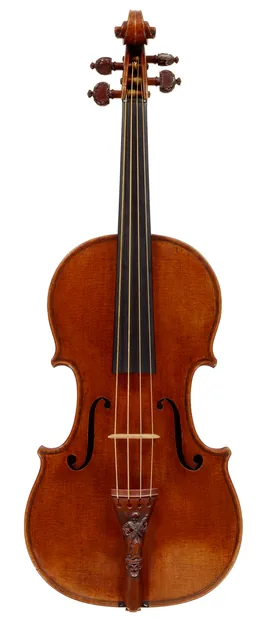
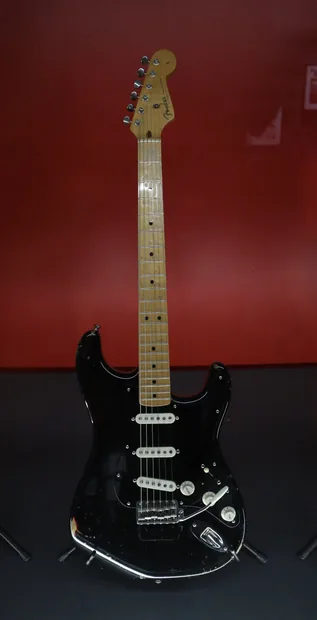
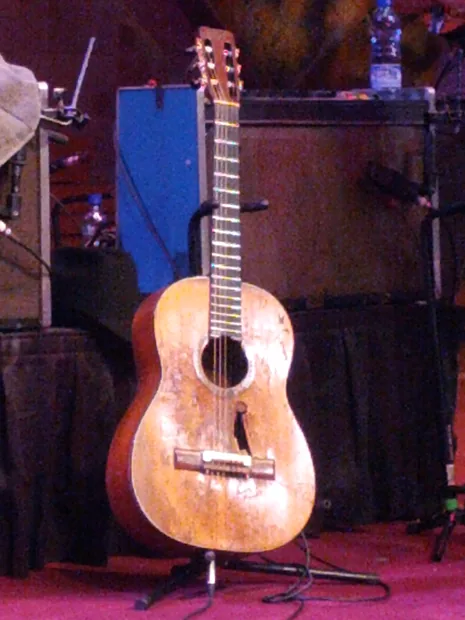
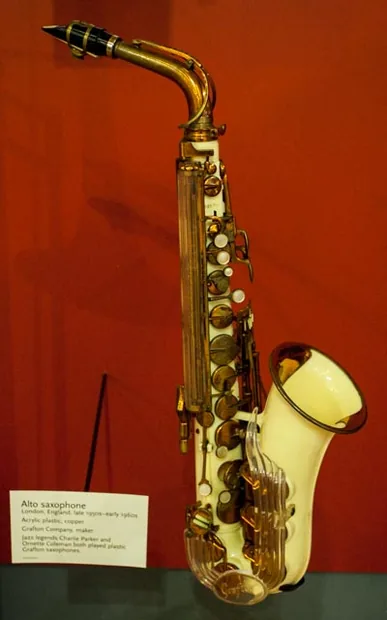
Sources: Gilmour figure from the Jim Irsay Collection sale, Christie's, March 2026, reported by Guitar World and ARTnews. Lady Blunt from Guinness World Records. Ringo Starr's kit via the Beatles Bible; reports vary between $2.1m and $2.2m depending on whether fees are counted. Freddie Mercury's piano from the Washington Post. Parker's Grafton from its own history. Les Paul shipping totals from Reverb. Stradivari survival counts from the Smithsonian. Private sales are not public record: a 1715 Stradivarius known as the “Baron Knoop” is reported to have changed hands for about $23m, which no auction has beaten. On the named instruments: Lucille via NPR; Trigger and the Red Special; Il Cannone, with the City of Genoa's own museum page; the Messiah; Lennon's Steinway from Guinness World Records.
Watch our guests on The Gear →04The Money
A record industry. Not record wages.
UK music has never been worth more to the economy. Most of the people making it are still scraping by.
Added to the UK economy, a record high. Exports hit £4.8bn.
A year, from music work. That's the average, so many earn a lot less.
Of those hit by Brexit, 95% said it cut their earnings. "Added to the economy" is gross value added, not total revenue.
Session musicians get a one-off fee. When the track is streamed, they get no share of that income, however big it gets.
Said session musicians should get streaming royalties, in a YouGov poll for the Musicians' Union.
Sources: UK Music, This Is Music 2025 (2024 figures). Musicians' Census, first report. Musicians' Union, written evidence to Parliament on streaming, including its #BrokenRecord YouGov poll.
What the work actually pays.
Most working musicians do some of all of this: sessions, gigs, functions, teaching. There is a published union minimum for nearly every one of them. Whether anybody pays it depends entirely on which kind of work it is.
In the studio
Up 40% under a new agreement between the record labels and the Musicians' Union. The old minimum was £130, and the union's own general secretary says it had barely moved in fifteen years.
Up 15% under the same deal. It applies to every UK recording session, not just the big three labels.
Playing live: what the card says
Per musician, not per band. A four-piece asking the recommended rate is asking for £669.
Per musician again, so £892 for four. Overtime is £55.72 an hour, at time and a half beyond the booked finish.
Musicians' Union National Gig rate card, April 2026, standard contract L1 and L2. Setting-up time is payable at the full hourly rate from whatever time you are required to be rigged and ready. In July 2024 the pub and club figure was £154.50.
And the fee is only the start of it. All of this is supposed to be on top, and almost none of it ever is.
| On top of the fee | Rate |
|---|---|
| Overtime | £55.72 an hour at time and a half, so £83.58 |
| Time spent travelling | £13.23 an hour, pro rata |
| Mileage | 56p a mile, with tolls, congestion and parking paid by the engager |
| Porterage: electric guitar and amp, bass and amp, double bass | £41.65 |
| Porterage: baritone sax, cello, bass clarinet, two saxes, pedalboards | £28.60 |
| Porterage: drum kit, percussion, harp, keys, PA | negotiate it yourself |
| Every extra instrument you play on the night | 15% of the fee, each |
| Getting home between midnight and 2am | £37.50 |
| Getting home after 2am, so an overnight | £147 |
| Meals and expenses | £65.80 a day |
| Breaks | at least 15 minutes for every 2 hours played |
The two cards nobody mentions
The pub and function rate is the one that gets quoted. There are others, and one of them is the only live work on any of these cards where you are an employee rather than a sole trader.
| Casual Stage rate: theatres and concert venues | Under 200 seats | Over 200 |
|---|---|---|
| One performance, plus a rehearsal the same day | £195.24 | £217.95 |
| Two performances, plus one rehearsal | £343.40 | £382.34 |
Per musician, three hours maximum for the performance and three for the rehearsal. An extra rehearsal on the same day is half a performance fee; on another day it is a whole one. Overtime runs at double time, £27.86 for every 15 minutes.
Hotels, restaurants, nightclubs, holiday centres and ships. Six sessions a week, four hours of playing each inside a five-hour call.
Holiday, pro rata. On a residency you are an employee: paid holiday, bank holidays at double time, two weeks' notice in writing, overtime at £46.84 an hour.
Sources: the Musicians' Union's National Gig, Casual Stage and Residency rate cards, all April 2026. Casual Stage is standard contract L1 and L2, Residency L3 and L4.
Theatre, where the fee becomes a wage
Sit in a pit for a run and you stop being paid per gig. These are collectively bargained weekly minimums, negotiated with the theatre industry rather than recommended at it, and they are the closest thing in this trade to a salary.
| Weekly minimum, per musician | A week | Per show |
|---|---|---|
| West End, leader, once nightly | £1,528.93 | £191.12 |
| West End, once nightly | £1,274.11 | £159.26 |
| UK Theatre, commercial, 12 shows | £1,011.55 | £84.30 |
| UK Theatre, subsidised, 12 shows | £912.36 | £76.03 |
| West End small theatre, under 700 seats | £849.40 | £106.18 |
| UK Theatre, commercial, 8 shows | £735.66 | £91.96 |
| UK Theatre, subsidised, 8 shows | £663.54 | £82.94 |
The small print is where the job shows itself.
£53.72 in the West End, £41.65 on a pub or function gig, £14.34 in a regional theatre. Same instrument, same stairs, three agreements.
A West End on-stage payment, for playing where the audience can see you instead of in the pit. Another £4.74 if they put you in a costume.
The musician's share in the West End, with the management putting in £43.74. There is no pension line on any casual gig card.
Doubling works backwards from the gig card too. On a pub gig every extra instrument adds 15% to the fee. In a regional theatre "up to two instruments" is included in the minimum, so the second one is free and only the third pays, at 10%. In the West End doubling takes the once-nightly minimum to £1,465.22 and trebling to £1,656.34. Per-show figures are ours, dividing by eight performances a week, or twelve where the contract says twelve.
Sources: the Musicians' Union's SOLT agreement for the West End and its UK Theatre agreement for everywhere else. These are the newest schedules the union publishes, and both have just run out: the UK Theatre one covered up to 5 April 2026 and the West End one up to 4 October 2026, with nothing posted since. Opera and dance companies are under separate agreements again.
And the one nobody prices
There is a card for a pub, a function, a theatre, a residency, a West End pit and a recording session. There is no card for the job most people picture when they hear "session musician": playing arenas, stadiums and festivals behind a named artist.
Source: the Musicians' Union's fair engagement guide on performing and touring with featured artists, April 2026.
Playing live: what the market pays
These are median fees from 5,210 UK bookings, after any agency commission, so they are what lands in the band's account.
| Gig | Line-up | Middle half | Median | Bookings |
|---|---|---|---|---|
| Pub or bar | Solo | £162 to £330 | £265 | 546 |
| Pub or bar | 3 to 4 piece | £275 to £600 | £350 | 379 |
| Pub or bar | 5 piece or more | £400 to £1,003 | £525 | 307 |
| Private party | 3 to 4 piece | £583 to £1,424 | £915 | 537 |
| Wedding | 3 to 4 piece | £812 to £1,563 | £1,138 | 1,620 |
| Wedding | 5 piece or more | £1,353 to £2,206 | £1,773 | 430 |
| Corporate | 5 piece or more | £1,025 to £1,708 | £1,337 | 73 |
Booked through an agency the client pays 25% to 50% on top of these figures. The band still gets the figure in the table. Source: the GigXchange Index, snapshot 2 November 2026, which pools booking data, public fee submissions and published rate cards, the union's included. It is a marketplace's own index rather than an official survey, and the submissions are not checked after the event.
Teaching
Here there is a recommended rate and a measured rate, published by two different organisations, and you can put them side by side.
For one-to-one and small-group teaching. Set deliberately to cover "all the financial obligations of being self-employed, such as holiday pay, sick pay, pension contributions and parental leave". Workshops are £295 a day.
From September 2025. The bottom fifth charge £35 or less, the top fifth £50 or more, and the full spread runs £9 to £105. Inner London's median is £55.75; Northern Ireland's is £34.
Neither of those is a one-off. The recommendation has gone up every single year. What teachers charge has not.
| From September | Union minimum | Median charged | Gap | Workshop day rate |
|---|---|---|---|---|
| 2021 | £36 | £35 | £1 | £208 |
| 2022 | £38.50 | £36 | £2.50 | £222 |
| 2023 | £40.50 | £37 | £3.50 | £250 |
| 2024 | £42.50 | £40 | £2.50 | £275 |
| 2025 | £44 | £40 | £4 | £285 |
| 2026 | £45.50 | not measured yet | £295 |
Union minimums are per academic year, so the 2025 row is the 2025-26 rate. The 2026-27 rise was 3.5%, pegged to CPIH. The median is what teachers told the ISM they charge from that September, so the two columns line up. The union's rate is for self-employed work only and it says plainly that it does not apply to employed teaching, which is where the lowest rates on this page are.
£44 recommended, £40 charged. In 2021 the gap was £1. Over those four years the recommendation rose 22% and the median rose 14%.
The lowest median of any setting in the survey, and the one most likely to be teaching the children who could not otherwise afford a lesson. The union's recommendation does not reach it, because it does not cover employed work.
| Setting | Self-employed | Employed |
|---|---|---|
| State-funded school | £37 | £36 |
| Music service or hub | £36 | £31 |
| Independent school | £48 | £38.23 |
| Specialist music school | see note | £43.80 |
Median hourly rates. The survey groups self-employed hub and specialist-school teachers together, at £36. Independent schools pay the most and now charge VAT on lessons, which teachers said is costing them pupils.
Up from 43% a year earlier.
No scale, no increment for years served. Many said they had not had a rise in years.
Would rather not be self-employed, but the school offered no other way to do the job.
The number of teachers in the survey working in schools at all fell from 35% to 21% in a single year, which the report puts down to forced self-employment, VAT on independent school fees and tighter rules on spending pupil premium. Sources: the Musicians' Union's music teaching rates of pay, including its own table of previous years, and the Independent Society of Musicians' annual survey of teaching rates, 1,084 respondents, run February to May 2026 by Naylor Research Partnership. The ISM publishes what teachers charge and does not recommend rates, because competition law stops it. The union does recommend, and sets its figure to include the holiday and sick pay nobody else is paying.
Session fees: BPI on the increases that took effect on 1 January 2026, with the pound figures as reported by the trade press, and Music Business Worldwide on the old £130 minimum. Teaching: as above, plus Hackney Education's peripatetic music teacher job pack.
Watch our guests on The Money →05The Body
Your ears are your career.
Years of loud rooms leave a mark. A large study compared professional musicians with everyone else.
More likely in professional musicians than in the general population.
Higher risk for professional musicians than for everyone else.
Hands, backs and shoulders matter too. We're gathering the best evidence on playing injuries and will add it here.
Source: Schink et al., Occupational and Environmental Medicine (2014). German health insurance data covering 2,227 professional musicians, 2004 to 2008. Results aren't split by instrument or genre.
Watch our guests on The Body →06The Head
Most musicians have been there.
In one of the biggest UK studies of musicians' mental health, most said they'd experienced anxiety or depression.
If that's you right now, you're far from alone. Music Support and Help Musicians are listed at the bottom of this page.
Source: University of Westminster study of 2,211 musicians, commissioned by Help Musicians, published 2017. Reported by Classic FM.
Watch our guests on The Head →07The Machine
A flood of AI music. Hardly anyone listening.
AI songs are pouring onto streaming services. So far, real listeners mostly aren't playing them.
were fully AI-made. That's around 90,000 AI tracks a day.
And up to 85% of streams on fully AI tracks in 2025 were fraudulent.
Listeners want to know what they're hearing. In a survey of 9,000 people across eight countries:
Projected loss to AI, according to CISAC, the global body for songwriters' and composers' societies.
- Universal and Warner have settled with AI song generator Udio. Warner has settled with Suno.
- Universal and Sony are still suing Suno. No ruling expected before late 2027.
- The UK government dropped its plan to let AI firms train on creators' work unless they opted out. No replacement yet.
- Global chart rules from July 2026 bar tracks that aren't substantially human-made. The UK chart isn't on the list yet.
Sources: Deezer (July 2026), including its Ipsos survey from November 2025. CISAC study, reported by Mixmag (December 2024). Suno lawsuit tracker (reviewed October 2026). Lewis Silkin on the UK government's March 2026 report. IFPI chart principles (July 2026).
Watch our guests on The Machine →08The Reckoning
Hard going. Most stay anyway.
For all the money worries, the people doing this tend to stick with it for the long haul.
Why they stay, and what they'd tell their younger selves, is something no survey captures. That's what the interviews are for.
Source: Musicians' Census, first report, via CMU and Help Musicians.
Watch our guests on The Reckoning →09Where to get help
You're self-employed. You're not on your own.
Work for yourself and you sit outside the safety nets employed workers get: no sick pay, no HR, no one chasing your invoices. These organisations exist to fill some of that gap. Check their sites for current details, because funds open and close.
Struggling right now?
One in three people working in music struggle with their mental health, according to Music Minds Matter. You don't have to be in crisis to call.
Music Minds Matter's helpline is free and open 24/7. Call or WhatsApp 0808 802 8008.
Music Support runs a helpline for anyone in the UK music industry dealing with mental health, drink, drugs or addiction, and for the people around them. Call 0800 030 6789 or email helpline@musicsupport.org.
Help Musicians
Help with money trouble, illness and injury, and hearing. Funding for creative projects, and a bullying and harassment helpline on 0800 088 2045.
Visit site → Mental healthMusic Minds Matter
Help Musicians' sister charity for mental health. Free 24/7 helpline by phone or WhatsApp, plus advice on stress, burnout and bullying.
Visit site → Mental health · AddictionMusic Support
Helpline, counselling, recovery groups, support for family and friends, and safe hubs at festivals.
Visit site → Therapy · Peer supportTonic Music
Free group therapy, peer support groups and wellbeing workshops, all online, for anyone working in music. Up to 12 funded 1-to-1 sessions if you qualify. Not a crisis service.
Visit site → Body · MindBAPAM
The medical charity for performing arts. Free consultations and clinics for health problems linked to your playing.
Visit site → Union · Legal · InsuranceMusicians' Union
Contract advice, legal help, chasing unpaid fees, public liability and instrument cover. Session specialists on staff.
Visit site → Membership · Legal · InsuranceISM
Independent Society of Musicians. In-house legal team, liability and legal expenses cover, plus health and wellbeing extras.
Visit site → FundingPRS Foundation
Grants for songwriters, composers and artists. Note: it funds people who write their own music, not performers only.
Visit site → FundingArts Council England
Developing Your Creative Practice grants, £2,000 to £12,000, for time to develop your work. No match funding needed.
Visit site →Sources: "One in three" and helpline details from Music Minds Matter, 2025 annual report and website. Everything else in this section comes from each organisation's own website. Universal Credit from GOV.UK.
About these numbers
We only use figures we can trace to a named source, and every one is linked above. Some studies are older or from outside the UK, and we say so where that's the case. Where nobody has measured something, we leave it blank rather than guess.
Last checked: 2 November 2026. Spotted something out of date? Tell us and we'll fix it.
Straight to your inbox, no faff.
We'll email you when a new one's up. Nothing else, we promise.